A Practical Guide to Choosing a Mobile App Development Company
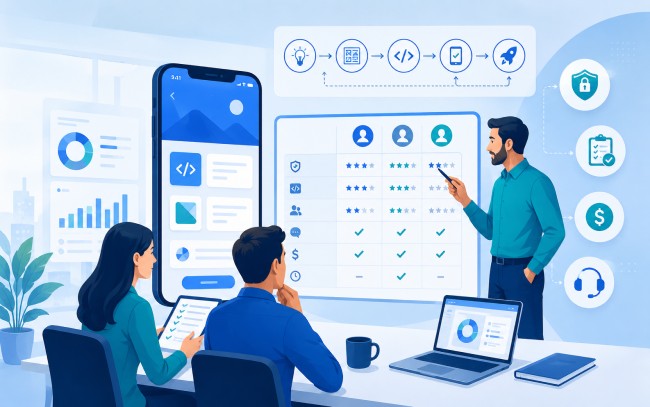
It is hard to choose a mobile application development company before you even receive any proposals. The founders and product managers need to figure out what they want commercially, technically and operationally from an initial idea. Otherwise, a good presentation may cover up bad planning, lack of experience or improper delivery model.
The best possible vendor selection process is one that evaluates vendors based on risk management principles rather than a portfolio battle. This process looks at how the company manages scope, challenges assumptions, manages uncertainty, and provides post-launch support for the product. Here is a framework to help decision-makers compare vendors fairly.
Define Your Product Requirements Before Contacting Vendors
A good brief would include the problem, the target audience, and the business outcome the app is supposed to achieve. The vendor should get sufficient information to determine whether the product helps improve internal processes, create income streams, deliver customer service, or establish a new digital channel for an existing business.
Find reliable engineering partners among these vetted mobile app development companies in the UK: https://luminarybrands.co.uk/blog/mobile-app-development-companies-uk/.
Clarify the App’s Purpose, Users, and Core Features
First, describe the core user experience from start to end. Detail the steps users have to take, the information that is required, and which systems the application needs to be interfaced with. This ensures that any prospective partner gets a practical idea and prevents any general proposal based on assumptions.
Identify which features are critical for the launch, while others can be postponed. Features such as authentication, payments, messaging, geolocation, analytics, and integration can have a different impact on the architecture and costs. The right order of priorities will allow recommending a realistic release to the firm.
Set Realistic Budget, Timeline, and Scope Boundaries
The budget planning process has to consider the following: discovery, interface design, development, testing, infrastructure, app store, and post-launch support. The omission of all these from the budget will result in a skewed comparison of the various vendors and, consequently, in eventual overspending on the project.
This is an essential thing to consider in the timeline, as well as dependencies of various sorts. The schedule for the launch date related to any event, financing, or seasonal campaign deserves special attention. Good vendors will question unrealistic dates and explain what scope changes will guarantee the quality of the product.
Choose the Right Development Model
The choice of the delivery model will define the degree of management, recruiting, and technical coordination that needs to be managed by the client internally. Different models give various degrees of control, flexibility, cost-effectiveness, and responsibility.
Compare Agencies, Freelancers, and In-House Teams
Agencies tend to offer multiple disciplines in one contract, which makes coordinating strategy, design, engineering, testing, and delivery management easier. Firms are particularly useful for complicated products and regulated sectors or for companies needing a full delivery capability without developing all the roles in-house.
Outsourcing may be ideal for projects that have well-defined objectives. The customer will have to handle multiple independent specialists in order to ensure smooth operations, but the downside is the coordination process. In-house experts offer direct control, although the disadvantage is the recruitment process and hiring cost.
Decide Between Local, Nearshore, and Offshore Partners
Location impacts working hours, availability of meetings, style of communication, and costs. Being on-site helps to reduce the complexities associated with organizing the workshops as well as access to stakeholders, while the nearshore arrangement usually offers considerable overlap in terms of costs. The offshore approach brings greater talent pool access but requires better documentation and coordination.
The decision should consider project complexity rather than geographic proximity alone. An effective remote business organization can operate more efficiently than an inefficient one closer at hand. It is vital to examine time-response issues, language proficiency, meeting management, and escalation techniques to understand how distance affects everyday delivery.
Evaluate Relevant Technical Experience
The technical competence of the firm must be evaluated based on evidence related to the product itself and not on technology lists. The managers have to find out if the firm has already solved similar engineering problems, understands the operational environment, and knows the reasons for selecting certain platforms and frameworks.
Review Projects Similar to Your Product
Seek out an example where there are similar transaction volumes, user types, integration needs, compliance requirements, or real-time elements. An application designed for health care, logistics, finance or field work might have unique workflows that do not exist in a regular consumer app. Similar complexity is more important than design style.
Candidates should be asked about their description of an especially tough decision they made with respect to their project and the ramifications of that decision. How the candidate responds to this question is an indication of how well they can cope with uncertainties and changing requirements.
Assess Platform and Tech Capabilities
It would be proper for the appropriate firm to make an evaluation that will decide whether development using native iOS, native Android or cross-platform is best for the objectives of the product. The advice should not be dictated by any preferred frameworks for all projects.
Back-end capabilities should be accorded the same consideration since mobile applications typically do not function in isolation. Analyze your knowledge regarding APIs, cloud computing, databases, identity, analytics, and third-party systems. The company that understands the entire ecosystem will help you detect any latent dependencies before it becomes an issue.
Examine the Company’s Development Process
The process of a company reveals how well it manages to turn the vague requirements into functional software. A good delivery process provides plenty of chances for the validation of decisions and the identification of risks and priorities before it is too late to change something, while a bad workflow will hide it.
Discovery, Planning, and Product Validation
The discovery process should result in some concrete deliverables that include but are not limited to user flows, technical requirements, priorities, risk register, prototypes, or delivery roadmap. Such deliverables provide a common language for decision-making in the future and help spot any missing pieces prior to spending development budget.
The process of validation could include anything from stakeholder interviews to usability tests, competitive research, or even technical experiments. Whatever method is chosen depends on the amount of uncertainty present. For instance, a complicated integration requires a proof of concept, whereas a new user flow might require a clickable prototype.
Design, Development, and Quality Assurance
Design and engineering processes should flow through an integrated set of steps rather than individual transitions. Review sessions help the developers identify impossible interfaces, designers safeguard usability, and owners verify the priorities. Through such a process, both usability and technical requirements of the interface can be addressed.
Testing must include function, interoperability, accessibility, security, performance, and release readiness. Find out when testing starts, what devices are tested, and how defects get prioritized. Tests that happen late in development often lead to rushed fixes and increased pressure on coders and management.
Communication and Project Visibility
Effective communication needs more than just constant meetings. It is up to the organization to set up reporting periods, project management tools, decision-makers, escalation paths, and change recording techniques. This will provide the stakeholders with an insight into the process without having to run around looking for it.
Ask for examples of status reports, sprint review sessions, or risk logs. Good reporting will show the difference between completed and pending work, highlight any blockages, and explain budgetary considerations. Even a dashboard overflowing with activity indicators can conceal issues when the outcome is not clear.
Investigate Reputation and Client Experience
Company rankings are quite helpful, but they often fail to describe how a business operates during troubled times. Better evaluations require an analysis of external reviews, client recommendations, experience, and examples illustrating how the contractor deals with obstacles, differences, financial issues, and relationships.
Verify Reviews, References, and Business Stability
References can be most valuable where the questions relate to challenging experiences rather than satisfaction. Ask former customers about how the organization has dealt with unexpected problems in terms of false assumptions, cost pressures, technological problems, and changing priorities.
Reviews from external sources may help determine trends in terms of communications, reliability, and business practices; however, these reviews need to be interpreted with caution. Ensure that projects are similar in size and complexity. Check on business stability, leadership stability, and whether the business seems capable of sustaining the product.
Plan for Security, Compliance, and Maintenance
The topic of security considerations needs to be addressed before any architectural decisions are made. It will be necessary for the company to show how it deals with authentication, encryption, permissions, secure coding, updating dependencies, and incident response.
Compliance and other related information specific to industries such as finance, healthcare, and education might also be required.
Final Checklist Before Signing the Contract
Before signing, make sure that the scope, assumptions, team, schedule, pricing model, deliverables, ownership terms, communications strategy, testing method, security responsibilities, and maintenance arrangements have been clearly documented.
Evaluate each shortlisted company using the same yardsticks so that the presentation does not overshadow delivery.
Conclusion
Selecting a development organization is both a business and management decision that will have long-lasting repercussions. The appropriate organization will be able to combine technical expertise, proper planning, execution and accountability. This ensures that the budget is protected while laying a better foundation for the future growth of the product.
The assessment process ensures that there is less uncertainty when entering into a contract since change will then become costly. The decision-makers should prefer facts to promises, evaluate proposals under equal circumstances, and assess companies’ reactions to complexity. This way, a stronger foundation can be laid for selecting a competent team.
Also Read
- Kutir Corporation: Building Future-Ready Technology Teams for Modern Businesses
- Pelo IT: Transforming Digital Strategy Through Human-Centred IT Consulting
- SCC Bracknell: Delivering Trusted IT Excellence in the Heart of Berkshire
- DPSIT: A Leading Sweden–Saudi IT Consulting Partner in Data Protection and Cloud Infrastructure